Solving Persistent Software Bugs: Muhammad's Success Story
Custom Software, Debugging, Engineering Solutions
The Bug That Wouldn’t Die: How Muhammad Solved John Morley’s Software Issue When Everyone Else Gave Up
When a critical custom software feature began failing without warning, multiple developers tried and walked away. This is the story of how Muhammad’s relentless debugging, engineering discipline, and refusal to ghost a struggling client finally killed “the bug that wouldn’t die” — and what that means for business and agency leaders who depend on reliable software.
When Custom Software Turns on You
John Morley’s team wasn’t dealing with a simple glitch. Their custom software issue was subtle, intermittent, and expensive. A core workflow would silently fail under certain load conditions, corrupting data and forcing staff into hours of manual cleanup. The worst part? It never misbehaved when a developer was watching.
Several vendors had already taken a shot. Each promised a quick fix, poked at the code for a few days, and then slowly faded away once the problem proved harder than expected. Emails slowed. Meetings slipped. Eventually, they simply stopped responding. John was left with a mission-critical system that everyone agreed was “hard” — but no one seemed willing to own.
Developer Persistence: The Difference Maker
Muhammad approached the project with a different mindset. Instead of promising an instant miracle, he promised persistence. For him, developer persistence isn’t a personality trait; it’s a professional standard. Complex systems fail in complex ways, and the only reliable path to resolution is a willingness to stay with the problem long after the “obvious” fixes have been exhausted.
From day one, Muhammad set expectations clearly: this bug might take time to reproduce, isolate, and eliminate — but he would not disappear when things got difficult. That commitment alone instantly differentiated him from the vendors who had come before. John didn’t just hire a coder; he hired someone who was prepared to own the outcome.
📌 Key Takeaway: The most valuable trait in a developer isn’t cleverness — it’s the willingness to stay with hard problems until they’re truly solved.
Inside the Debugging Techniques That Finally Worked
The turning point wasn’t a stroke of luck; it was the result of disciplined debugging techniques applied over days and weeks, not hours. Muhammad began by mapping the entire failing workflow: every service call, database interaction, and integration touchpoint. He then built a timeline of when failures occurred, what users were doing, and what the system believed was happening at the time.
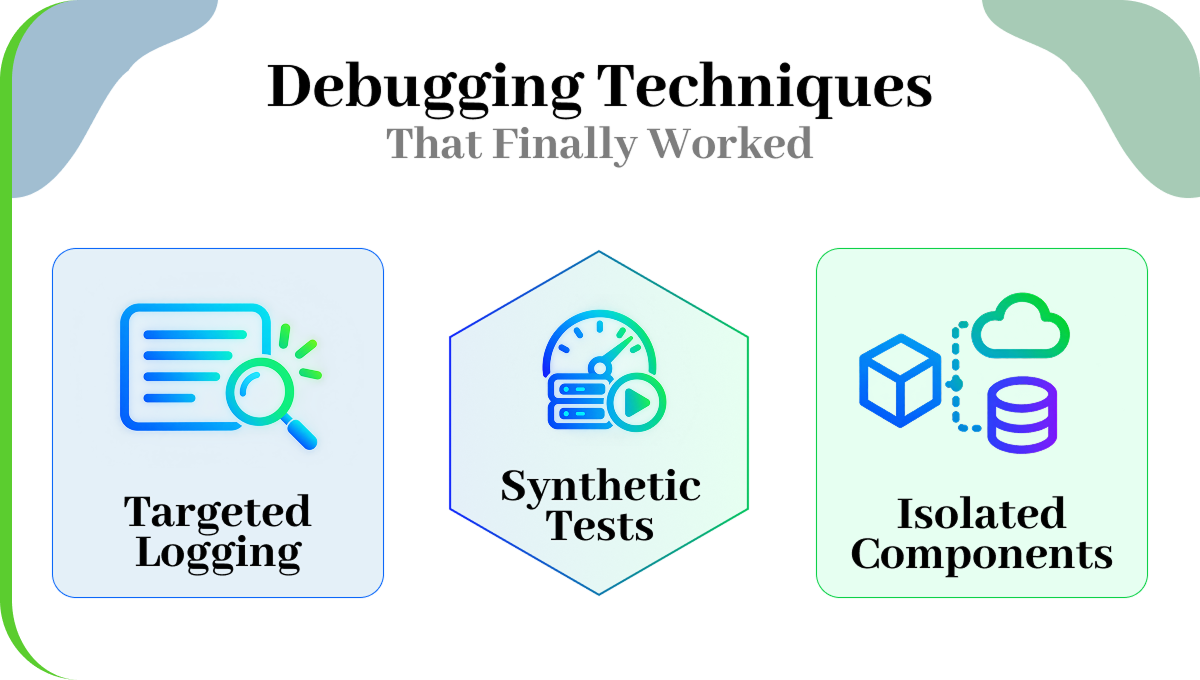
He added targeted logging around suspected bottlenecks instead of flooding the system with noise.
He created synthetic test scenarios to mimic real-world load and timing, running them repeatedly until the failure surfaced on demand.
He isolated components, swapping out external dependencies to confirm whether the root cause lived inside or outside John’s codebase.
Slowly, a pattern emerged: a race condition triggered when two specific operations overlapped under a precise timing window. It was the kind of defect that can live for years in production, only surfacing when the stars align in exactly the wrong way. No wonder others had missed it.
From Bug Hunt to Engineering Solution
Finding the bug was only half the battle. Muhammad’s value came from turning that insight into a robust engineering solution. Rather than slapping on a quick patch, he redesigned the affected workflow to remove the fragile timing dependency entirely. Operations were made idempotent, concurrency was controlled explicitly, and defensive checks were introduced to prevent data corruption even if external services misbehaved.
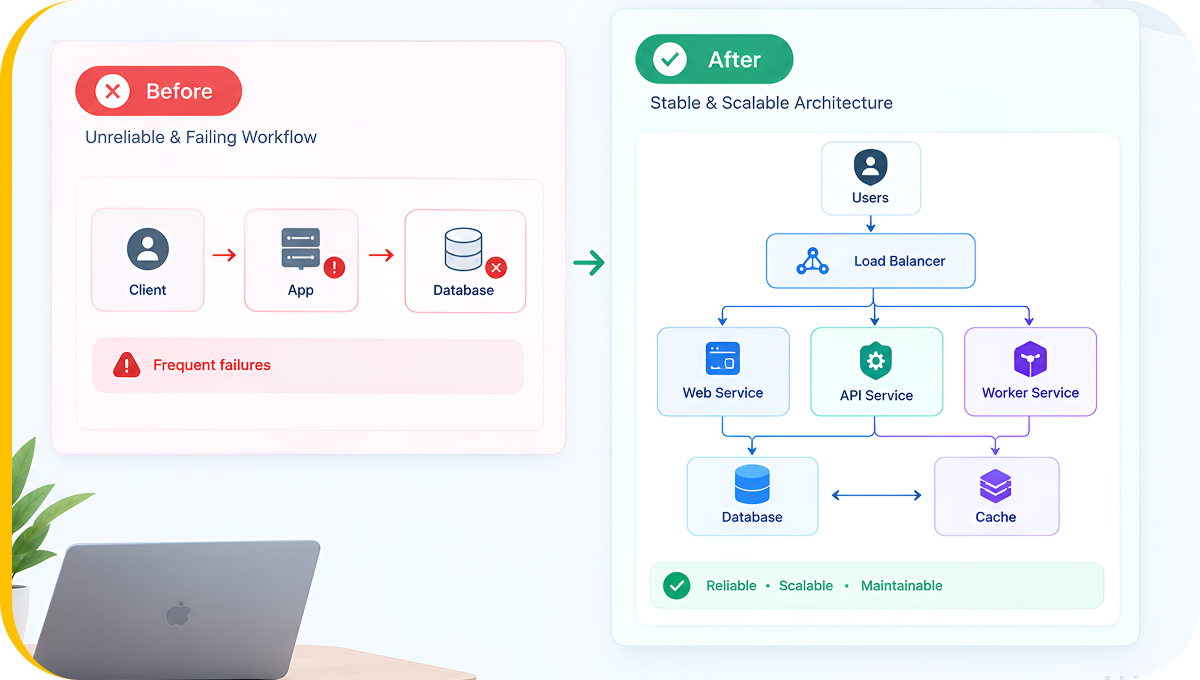
Clear engineering solutions turn fragile workflows into predictable, scalable systems.
The result? The failure disappeared — not just in tests, but in production, under real customer load. What had once been an unpredictable liability became one of the most reliable parts of the system. John didn’t just get a fix; he gained a stronger architecture and renewed confidence in his technology stack.
Client Reviews: Proof That Persistence Pays Off
John’s client reviews of the engagement highlight two things again and again: Muhammad’s communication and his refusal to quit. While others had gone silent when the problem grew thorny, Muhammad doubled down — sharing findings, explaining trade-offs, and outlining next steps at every stage. For a business owner under pressure, that transparency was as valuable as the final fix itself.
“Muhammad was very helpful, knowledgeable, and didn't give up trying to find a solution to my software issue.”
— John C. Morley, Founder & Owner,
The testimonial that emerged from this project isn’t just praise; it’s a case study in why persistence plus process beats promises of “quick wins” every time. John didn’t just feel heard; he felt partnered with, even during the most frustrating days of the investigation.
Strategic Lessons for Business and Agency Leaders
For business owners and agencies, the strategic lesson is clear: your risk isn’t just bad code; it’s fragile partnerships. Complex custom software issues are inevitable as systems grow. The real question is whether you have a team that leans in when the bugs get ugly — or one that quietly disappears when the answers aren’t obvious.
A team that refuses to ghost when facing difficult bugs protects more than uptime. It protects customer trust, staff morale, and your ability to scale without fear that a hidden defect will surface at the worst possible time. Muhammad’s work with John shows that the right mix of developer persistence, thoughtful debugging techniques, and solid engineering solutions can turn even a nightmare bug into a competitive advantage.
💡 Pro Tip: When evaluating vendors, don’t just ask how they fix bugs — ask how they communicate and stay engaged when the fix takes longer than expected.
Don’t Live with “Unsolvable” Issues: Book an Executive Architecture Audit
If you’re living with “that one issue” everyone knows about but no one has fixed, you don’t have to accept it as normal. An Executive Architecture Audit is designed precisely for these situations. Instead of another surface-level bug hunt, you get a structured review of your system’s design, failure modes, and risk points — led by engineers who have proven they will stay with the problem until it’s truly understood.
During the audit, Muhammad and his team walk your leadership and technical stakeholders through where your architecture is strong, where it’s fragile, and where persistent bugs are likely hiding. You leave not just with a list of issues, but with a prioritized roadmap of engineering solutions and a partner committed to seeing them through.
The bug that wouldn’t die in John Morley’s system is gone — not because it was simple, but because someone was willing to do the hard, methodical work. If your software is holding your business hostage, it may be time to bring that same mindset to your own systems. Book an Executive Architecture Audit, and give your most stubborn issues a team that refuses to give up — or to ghost you — when it matters most.
📌 Ready for Your Executive Architecture Audit?
If you’re dealing with recurring, “unsolvable” issues in your custom software, you don’t have to keep patching over the symptoms.
Click here to book your Executive Architecture Audit and get a senior engineering review of your systems, along with a clear, prioritized action plan.