The 60-Second Rule: How Systems and Dedicated VAs Drive Elite Speed-to-Lead
Sales Operations, Revenue Operations, Speed To Lead
The 60-Second Rule: How Systems and Dedicated VAs Drive Elite Speed-to-Lead
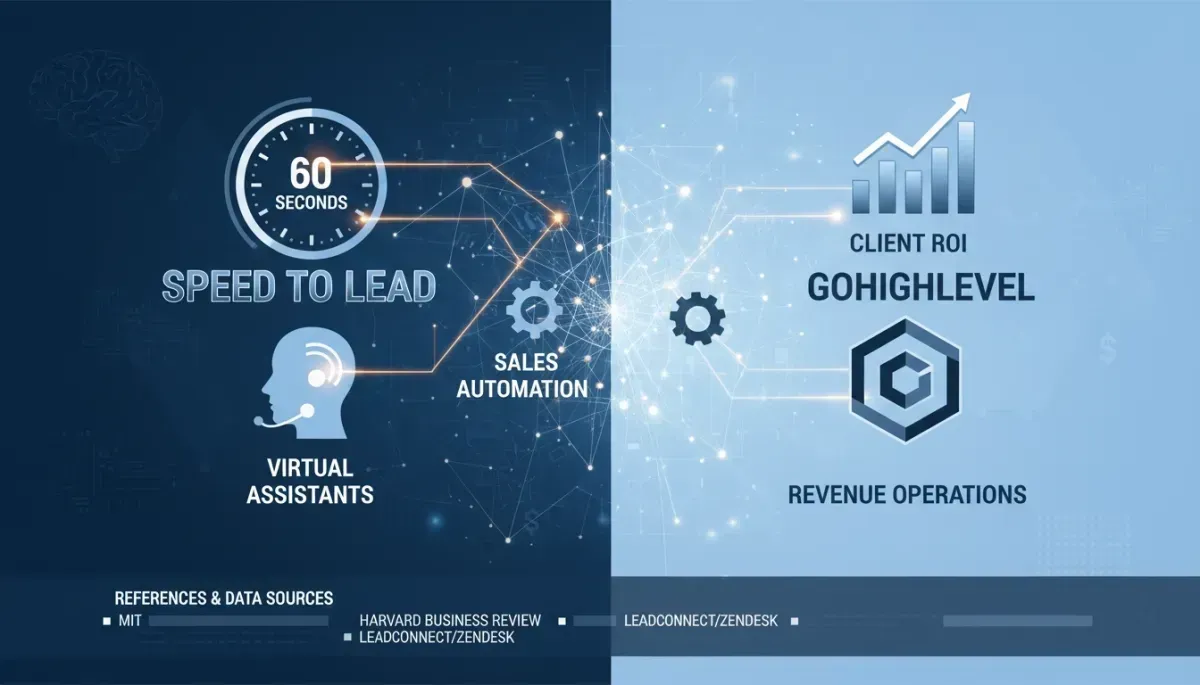
This article examines how a dual-layer Speed To Lead model—combining structured systems, Virtual Assistants, and advanced Sales Automation—enables businesses and agencies to operationalize the “60-second rule” and materially improve Client ROI and end-to-end Revenue Operations performance.
Why Speed To Lead Matters in Modern Revenue Operations
Empirical research has consistently demonstrated that Speed To Lead is one of the most powerful yet underexploited levers in contemporary Revenue Operations. A seminal study by the MIT Sloan School of Management found that firms responding to inbound leads within five minutes were up to 100 times more likely to make contact than those waiting 30 minutes or longer, and 21 times more likely to qualify a lead compared with responses after 30 minutes (MIT Sloan Management Review, 2011). Harvard Business Review similarly reported that many organizations take hours—or even days—to respond to digital inquiries, despite clear evidence that conversion probability decays sharply within the first hour (Harvard Business Review, 2011).
In this context, the “60-second rule” represents an elite benchmark: the operational ability to acknowledge, route, and initiate meaningful contact with a new lead in under one minute. Achieving this consistently requires more than isolated tools; it demands an integrated architecture of systems, Virtual Assistants, and Sales Automation orchestrated within a disciplined revenue framework.
The Dual-Layer Speed-to-Lead Model: Systems + Human Assist
High-performing organizations increasingly adopt a dual-layer speed-to-lead model. The first layer is system-driven: marketing forms, chat widgets, and inbound call flows are connected to a centralized platform—often an all-in-one solution such as Gohighlevel—that executes immediate Sales Automation actions. These typically include instant email acknowledgements, SMS notifications, and automated lead scoring and routing rules. Platforms like LeadConnect and Zendesk Sell have reported that automated, multi-channel follow-up sequences can raise initial contact rates by 30–50% when compared with manual outreach alone (LeadConnect, 2022; Zendesk, 2023).
The second layer is human, powered by trained Virtual Assistants (VAs) embedded into the organization’s Revenue Operations stack. While automation handles the first-touch acknowledgement, VAs provide rapid, context-aware human engagement—calling, qualifying, and scheduling within the same initial window. This dual-layer configuration ensures that no lead is left unattended while also preserving the relational nuance that only human interaction can offer, particularly in complex or high-ticket sales environments.

Coordinated automation and VA outreach compress response times while preserving human connection.
Operational Blueprint: From Lead Capture to Sub-60-Second Contact
1. Unified Capture and Routing via Gohighlevel
The operational blueprint begins with consolidating all inbound channels—web forms, landing pages, chat, social ads, and phone calls—into a single system of record. Platforms such as Gohighlevel enable this consolidation by integrating marketing, CRM, and communication tools into one environment. When a lead submits an inquiry, the system instantly:
Creates or updates the contact record with full attribution data.
Triggers Sales Automation workflows (email, SMS, and voicemail drops).
Routes the lead to the appropriate pipeline stage and owner based on rules.
2. Automation-First Acknowledgement and Notification
Within seconds, the system issues an automated acknowledgement to the prospect, sets expectations on response timing, and alerts the assigned team. Research from Zendesk indicates that customers who receive rapid confirmation—even if final resolution occurs later—report significantly higher satisfaction and willingness to engage in subsequent conversations (Zendesk Customer Experience Trends, 2023). At this stage, Sales Automation ensures that every lead is recognized and queued without relying on human availability.
3. Virtual Assistants as the Human Acceleration Layer
Dedicated Virtual Assistants then act as the human acceleration layer. Equipped with structured call scripts, qualification frameworks, and calendar access inside Gohighlevel or a comparable CRM, VAs can place a call, send a personalized message, or initiate a two-way SMS conversation within the first 60 seconds. This configuration is particularly effective for agencies managing multiple client accounts, as VAs can be cross-trained on standardized processes while still representing each brand distinctly.
4. Closed-Loop Revenue Operations and Continuous Optimization
Finally, the dual-layer model is embedded into a closed-loop Revenue Operations framework. Response times, contact rates, appointment set rates, and downstream revenue are tracked across both automated and VA-driven touchpoints. Harvard Business Review has emphasized that firms adopting integrated revenue operations practices—aligning marketing, sales, and customer success around shared data and metrics—achieve higher growth and more predictable pipelines (Harvard Business Review, 2020). By continuously analyzing performance, organizations can refine routing rules, adjust automation cadences, and improve VA scripts to further compress time-to-contact and enhance conversion.
Impact on Client ROI for Businesses and Agencies
The economic rationale for the 60-second, dual-layer model is clear. Faster Speed To Lead improves contact rates, which in turn increases the volume of qualified opportunities entering the pipeline. LeadConnect has reported that organizations implementing structured, multi-touch follow-up sequences can realize up to a 3x increase in meetings booked from the same lead volume (LeadConnect, 2022). When combined with VA support, agencies often observe substantial uplifts in show rates and deal velocity, translating into higher Client ROI without proportionally increasing media spend.
For agencies, this model also enhances perceived value. By offering white-labeled Virtual Assistants and done-for-you Sales Automation inside platforms like Gohighlevel, agencies move beyond lead generation to deliver measurable revenue outcomes. This repositioning—from “lead vendor” to strategic Revenue Operations partner—supports higher retainers, longer contract terms, and stronger case studies that further compound Client ROI over time.
Conclusion: Institutionalizing the 60-Second Standard
The evidence from MIT, Harvard Business Review, and industry platforms such as LeadConnect and Zendesk converges on a single conclusion: response speed is a decisive competitive advantage in digital-first markets. Organizations that institutionalize the 60-second standard through a dual-layer Speed To Lead model—integrating robust systems, disciplined Sales Automation, and well-trained Virtual Assistants—are positioned to outperform peers on conversion, retention, and long-term Client ROI. For both businesses and agencies, the path forward lies in treating speed-to-lead not as an isolated tactic, but as a core design principle of modern Revenue Operations.
References & Data Sources
MIT Sloan Management Review. (2011). The Short Life of Online Sales Leads. Massachusetts Institute of Technology.
Harvard Business Review. (2011). The Short Life of Online Sales Leads. Harvard Business Publishing.
Harvard Business Review. (2020). Aligning Sales and Marketing in the Age of AI. Harvard Business Publishing.
LeadConnect. (2022). Lead Response and Meeting Conversion Benchmarks. LeadConnect Industry Report.